
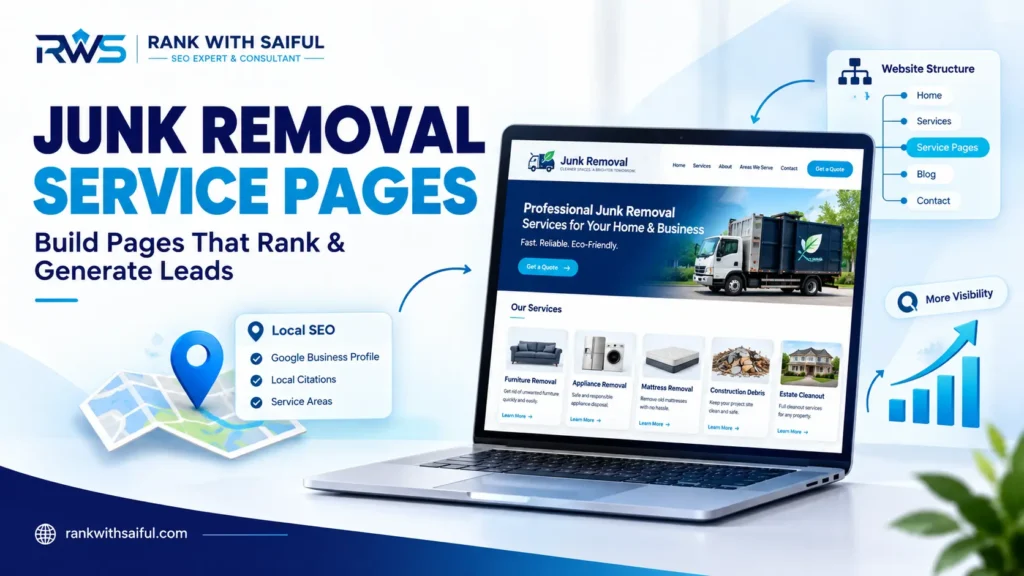
If you run a junk removal company, your website should do more than simply list your services.
A visitor who lands on your website may be looking for furniture removal, appliance removal, construction debris cleanup, estate cleanouts, mattress removal, or another specific service. If every service is buried on one general page, both the visitor and search engines have less context about what your business actually offers.
This is where dedicated service pages can make a real difference.
A well-built service page gives one service its own space, explains the problem you solve, answers the customer’s questions, and creates a clear path toward contacting your business.
For a junk removal company, service pages can become one of the most important parts of the website’s SEO and lead-generation structure.
But there is an important distinction:
Creating more pages does not automatically create better SEO.
The goal is not to create dozens of nearly identical pages simply to target more keywords. The goal is to create genuinely useful pages for services that customers actually search for and that your business genuinely provides.
Let’s look at how to do that properly.
Why Service Pages Matter for Junk Removal Companies
Imagine someone searches for:
“junk removal near me”
They are not necessarily looking for a general article about junk removal.
They already have a specific problem.
They have unwanted items that need to be removed.
Now compare a website that simply says:
We offer junk removal services. Contact us today.
with another website that has a dedicated service page explaining:
- What the service includes
- What types of items are accepted
- How the removal process works
- What customers should do before pickup
- Areas served
- Common questions
- How to request a quote
The second page gives the visitor much more useful information.
It also gives search engines clearer context about what the page is actually about.
A useful service page should be created for the customer first, with SEO supporting the content rather than controlling every sentence.
Don’t Put Every Service on One Page
One common website structure for local service businesses looks something like this:
Services
We provide junk removal, furniture removal, appliance removal, mattress removal, construction cleanup, estate cleanouts, and more.
Then everything is explained in a few short paragraphs.
The problem is not that this information is incorrect.
The problem is that every service receives very little attention.
A customer searching specifically for appliance removal may have to search through a general page to find the information they need.
Instead, consider creating separate pages for important services.
For example:
- Junk Removal
- Furniture Removal
- Appliance Removal
- Mattress Removal
- Construction Debris Removal
- Estate Cleanout
- Hot Tub Removal
The exact services should depend on what the company actually offers.
Build pages around real services—not keywords alone.
Start With Your Actual Services
Before creating SEO pages, make a list of the services your company genuinely provides.
General Junk Removal
This can be the main service page explaining the company’s overall junk removal offering.
Furniture Removal
This page can cover couches, tables, chairs, dressers, cabinets, and other household furniture the company accepts.
Appliance Removal
This can focus on items such as refrigerators, washers, dryers, ovens, and other accepted appliances.
Mattress Removal
This page can explain mattress and box spring removal, preparation requirements, and the pickup process.
Construction Debris Removal
This can target customers dealing with renovation or construction waste, provided the company actually accepts those materials.
Estate Cleanout
This can address customers who need larger-scale cleanout assistance after a move, property transition, or estate situation.
The important point is that each page should represent a real business service.
One Service Page Should Have One Clear Purpose
A strong service page should answer a simple question:
What does this page help the customer accomplish?
For example:
A furniture removal page should help someone who needs unwanted furniture removed.
An appliance removal page should help someone who needs an unwanted appliance picked up.
A construction debris removal page should help someone understand whether the company can handle their particular type of debris.
This keeps the page focused.
It also prevents the content from becoming a collection of unrelated keywords.
What Should a Junk Removal Service Page Include?
There is no universal template that every business must follow.
However, a useful service page should answer the questions a potential customer has before contacting the company.
Here is a practical structure.
1. Clear Page Heading
Start with a straightforward heading describing the service.
For example:
Furniture Removal Services
or:
Appliance Removal Services
The customer should immediately understand what the page is about.
2. A Strong Introduction
The first section should quickly explain:
- What service you provide
- Who it is for
- What types of items you handle
- Where the service is available
- What the customer can do next
Avoid starting with a long generic SEO introduction.
The customer already has a problem.
Get to the point.
For example:
Need to get rid of an old couch, table, dresser, or other unwanted furniture? Our furniture removal service helps homeowners and businesses clear out unwanted items without having to handle the heavy lifting themselves.
That is much more useful than:
Welcome to our website. We are a professional company dedicated to providing the best services to our customers.
3. Explain What the Service Includes
This section should remove uncertainty.
For a furniture removal page, you might explain:
Furniture we may remove:
- Sofas and couches
- Tables
- Chairs
- Dressers
- Cabinets
- Bed frames
- Office furniture
- Other accepted furniture items
Only list items the business actually accepts.
If there are restrictions, explain them clearly.
This is important because customers do not want to call a company only to discover that their item cannot be removed.
4. Explain What Customers Should Expect
A good service page should also explain the process.
How Furniture Removal Works
1. Request a Quote
Contact the company and provide information about the items that need to be removed.
2. Schedule the Pickup
Choose an available date and time.
3. Removal Team Arrives
The team assesses the items and confirms the scope of the job.
4. Items Are Removed
The crew handles the removal and loading process.
5. The Space Is Cleared
The unwanted items are taken away according to the company’s disposal, recycling, or donation practices.
A simple process like this can answer questions before the customer even makes a phone call.
5. Explain Who the Service Is For
Not every customer has the same situation.
Depending on the service, you can explain how it may help:
- Homeowners
- Renters
- Landlords
- Property managers
- Businesses
- Contractors
- Real estate professionals
Only mention customer types the company actually serves.
This section can also help visitors recognize that the service applies to their situation.
6. Add Service-Area Information Naturally
For a local junk removal company, location information matters.
But there is a difference between explaining where you actually provide service and creating dozens of nearly identical city pages.
On a service page, you can naturally mention the primary service area.
For example:
Our furniture removal service is available to customers in [City/Area] and surrounding communities.
Then provide a link to the relevant location or service-area page if one exists.
Don’t turn the paragraph into:
Furniture removal in City A, furniture removal in City B, furniture removal in City C…
That doesn’t make the page more useful.
The location information should help the customer understand whether the service is available to them.
7. Answer Common Customer Questions
Think about what a customer would ask before booking.
For furniture removal, questions might include:
Do you remove furniture from inside the home?
Explain the company’s actual policy.
Do I need to move the furniture outside?
Explain whether the crew handles indoor removal.
What types of furniture do you accept?
List the accepted items and relevant restrictions.
Can you remove multiple pieces at once?
Explain how larger jobs are handled.
How much does furniture removal cost?
If pricing varies, explain the factors that influence the quote rather than publishing a misleading fixed price.
These questions make the page more useful because they address real customer concerns.
8. Show What Makes the Service Different
This does not mean writing exaggerated claims.
You don’t need:
We are the #1 furniture removal company.
Instead, explain genuine business characteristics.
For example:
- Flexible scheduling
- Upfront quote process
- Residential and commercial service
- Full-service removal
- Same-day availability, if genuinely offered
- Recycling or donation practices, if genuinely provided
Only include claims the business can actually support.
9. Use Original Photos When Possible
A service page becomes much more convincing when visitors can see the actual business.
For example, a furniture removal page could include:
- Company truck
- Removal crew
- Before-and-after photos
- Furniture being loaded
- Equipment
- Completed cleanout
- Real service locations
Original images can make the page feel more trustworthy than a generic stock image.
For a local business website, real-world evidence can also help visitors understand that an actual company performs the service.
10. Connect Service Pages With Internal Links
This is where your website structure becomes much stronger.
Suppose you have:
Homepage
↓
Junk Removal Services
↓
Furniture Removal
Appliance Removal
Mattress Removal
Construction Debris Removal
You can then connect these pages naturally.
For example, your furniture removal page might mention:
If you’re clearing out several different types of unwanted items, you may also want to explore our Junk Removal Services page.
Your blog articles can also link back to relevant service pages.
Use descriptive anchor text that tells the reader what they will find after clicking.
Instead of:
Click here
use:
Explore our furniture removal services
or:
Learn more about appliance removal
The link should make sense naturally within the surrounding content.
11. Don’t Forget the Blog
Your service pages should not exist in isolation.
Your blog can support them.
For example:
Service Page:
Furniture Removal
Supporting articles could cover topics such as:
- What Happens to Old Furniture After Removal?
- How to Prepare Your Home for Furniture Removal
- When Should You Replace Old Furniture?
- What Can a Junk Removal Company Take?
The blog article can then naturally link back to the relevant service page.
This creates a stronger relationship between informational content and commercial pages.
Instead of having a website full of disconnected articles, you’re building a useful content system.
12. Avoid Creating Thin Service Pages
Creating a separate page for every keyword variation is not a good strategy.
For example, you probably don’t need separate pages for:
- Furniture Removal
- Furniture Removal Service
- Furniture Removal Company
- Furniture Pickup
- Furniture Pickup Service
- Furniture Disposal
- Furniture Removal Near Me
if all seven pages would contain essentially the same information.
That creates unnecessary duplication.
Instead, build one strong page that genuinely covers the service and the questions customers have around it.
The goal should be to create useful content for people—not pages created simply to capture every possible keyword variation.
13. Don’t Copy the Same Template Across Every City
This is another issue local businesses should watch carefully.
Imagine creating:
Furniture Removal in Kitchener
Furniture Removal in Waterloo
Furniture Removal in Cambridge
and changing only the city name.
If the rest of the page is almost identical, the pages provide little additional value.
A location page should exist because there is a genuine reason for the business to serve that location and because the page can provide useful, location-specific information.
The same principle applies to service pages.
Don’t create pages simply because a keyword exists.
Create them because the customer needs the information.
14. Make the Page Useful Before Making It Optimized
SEO should support the page—not control every sentence.
A useful service page should feel natural when someone reads it without knowing anything about SEO.
Ask:
Can a customer understand the service in less than a minute?
Can they tell whether their item is accepted?
Can they understand how the process works?
Can they find the service area?
Can they find a clear way to contact the company?
If the answer is yes, you’re already moving in the right direction.
Then optimize the page’s titles, headings, URLs, images, links, and other relevant elements around the actual content.
15. Add a Clear Call to Action
A service page should make the next step obvious.
Depending on the business, that might be:
Request a Free Quote
Call for Junk Removal
Schedule a Pickup
Get a Removal Estimate
The CTA should match the actual process.
Don’t make the customer hunt for a phone number after reading the entire page.
For mobile visitors especially, make contacting the business simple.
A Simple Junk Removal Service Page Structure
If you’re building a service page from scratch, this is a practical framework:
Furniture Removal Services
Introduction
What We Remove
How Furniture Removal Works
Who We Serve
Service Areas
Why Customers Choose This Service
Frequently Asked Questions
Related Junk Removal Services
Clear Call to Action
This structure is simple, but it gives you enough room to answer real customer questions without turning the page into an SEO checklist.
How Many Service Pages Should a Junk Removal Company Have?
There is no magic number.
A small junk removal company might genuinely need only a handful of strong service pages.
Another company with a broader service offering may need more.
The right number depends on:
- Services actually offered
- Customer demand
- Business model
- Search intent
- Geographic coverage
- Content quality
- Whether each page provides something genuinely useful
I’d rather see a junk removal website with six excellent service pages than thirty weak pages created only to target slightly different keywords.
Quality and usefulness should come first.
Final Thoughts
A strong junk removal website should not force every service into one generic page.
When a business offers several distinct services, dedicated service pages can give each service the space needed to explain what it is, who it helps, what customers can expect, and how to take the next step.
But the strategy isn’t simply:
More pages = better SEO.
The better approach is:
Real service → useful page → clear search intent → helpful information → logical internal links → easy conversion path.
That creates a website that is easier for customers to navigate and easier for search engines to understand.
And that’s the real purpose of a service-page strategy.
Frequently Asked Questions
Should every junk removal service have its own page?
Not necessarily. Create a dedicated page when the service is genuinely offered and there is enough useful information to make that page valuable to customers.
How long should a junk removal service page be?
There is no ideal word count. The page should be long enough to answer important customer questions without adding unnecessary information. Focus on completeness and usefulness rather than hitting a specific word count.
Should I create separate pages for every city I serve?
Not automatically. A location page should provide genuine value and relevant local information. Avoid creating large numbers of nearly identical pages with only the city name changed.
Should service pages target keywords?
Yes, but keywords should reflect the actual service and customer intent. The goal is not to insert keywords repeatedly. The goal is to clearly explain the service people are searching for.
Can blog posts link to service pages?
Absolutely. Relevant blog posts can naturally link to the service pages they support. Descriptive anchor text can also help users and search engines understand the destination page.
Join The Conversation