
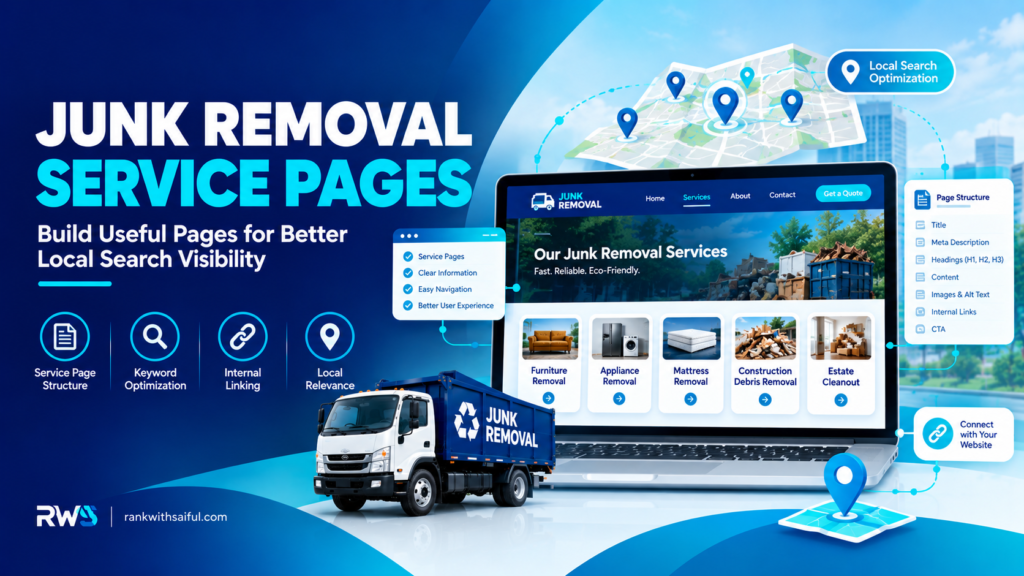
A potential customer searching for furniture removal may have a different need from someone looking for construction debris removal or an estate cleanout. If a junk removal website treats every service as the same thing, visitors may struggle to find the information they need.
That is why service pages deserve careful planning.
A well-structured junk removal website should make it easy for visitors to understand which services a business offers, what each service includes, which areas it serves, and how to request a quote.
From a Local SEO perspective, useful service pages also help organize website content around the business’s actual services and the search intent behind relevant queries.
In this guide, we’ll look at how to plan, structure, and optimize junk removal service pages without creating unnecessary pages, repeating keywords, or publishing thin content.
“A strong service-page strategy should work alongside a broader Local SEO strategy for Junk Removal companies.”
What Are Junk Removal Service Pages?
A junk removal service page is a website page dedicated to a particular service that a company offers.
For example, a junk removal company may provide furniture removal, appliance removal, mattress removal, garage cleanouts, and construction debris removal.
A business might explain all these services briefly on its homepage. However, when a service needs more detailed information, a dedicated page can give customers a clearer understanding of what to expect.
A useful service page answers practical questions:
-
What does the service include?
-
Which items can the company remove?
-
Are there any restrictions?
-
How does the removal process work?
-
Which locations does the business serve?
-
How can a customer request a quote?
The objective is not to create a separate URL for every possible keyword. It is to give each important service enough useful information to serve its intended audience.
Why Service Pages Matter for Local SEO
Service pages connect what a business offers with what potential customers are trying to find.
When a visitor lands on a page dedicated to appliance removal, they should not have to search through unrelated content to understand whether the company handles that service.
A clearly organized website can also help search engines discover and understand the relationships between the homepage, individual services, supporting articles, and relevant location information.
There are several practical benefits to planning service pages carefully.
They Explain Individual Services Clearly
A dedicated page gives a business room to explain a service in more detail than a short homepage section allows.
For example, a furniture removal page can explain which types of furniture are accepted, how pickup works, and what information a customer should provide when requesting a quote.
They Match Specific Customer Needs
People do not always search using the broad phrase “junk removal.”
Some may be looking for mattress removal, while others may need help clearing a garage or removing renovation debris.
Useful service pages let the business address these different needs without forcing every topic into one generic page.
They Create a Better Website Structure
Service pages can be connected to the homepage, related services, location pages where appropriate, and relevant blog articles.
This helps visitors move naturally between related information and gives search engines clearer paths for discovering important content.
They Support More Useful Customer Journeys
A service page should help someone understand the service and take the next step.
Depending on the business, that next step may be calling, requesting a quote, completing a contact form, or checking service availability.
Better organization does not guarantee rankings or leads, but it can make the website more useful and easier to navigate.
Which Junk Removal Services Deserve Their Own Pages?
The answer depends on the services the business actually offers, the information customers need, and whether a separate page would provide meaningful value.
Potential service pages include:
-
Furniture Removal
-
Appliance Removal
-
Mattress Removal
-
Construction Debris Removal
-
Garage Cleanout
-
Estate Cleanout
-
Hot Tub Removal
-
Yard Waste Removal
These are examples, not a checklist every company must follow. A business should not publish a page for a service it does not provide.
“Before creating pages, research the services customers search for and organize them through Junk Removal keyword research.”
Start With the Real Service List
Before creating pages, document the company’s actual services and any relevant limitations.
For each service, consider:
-
What items or materials are accepted?
-
What types of jobs does the company handle?
-
Are there restrictions or special requirements?
-
Which service areas are covered?
-
What questions do customers usually ask?
This research helps determine which services need dedicated pages and which can be grouped together.
Avoid Creating Pages Without a Clear Purpose
Two closely related services do not automatically require separate URLs.
If separate pages would contain nearly identical information and answer the same customer need, one stronger page may be more useful.
For example, a business should evaluate whether two similar furniture-removal offerings genuinely need separate pages or whether they belong together on one comprehensive page.
The decision should be based on meaningful differences in the service and the user’s needs—not simply on the number of keyword variations available.
How to Structure a High-Quality Junk Removal Service Page
Every service page should have a clear purpose and an easy-to-follow structure.
The following framework can be adapted to the company’s services and customers.
1. Write a Clear, Descriptive Page Title
The page title should describe the service accurately and help users understand what they will find.
For a furniture removal page, a title might be:
Furniture Removal Services | Business Name
If a location is genuinely important to the page, it may be included naturally. Avoid repeatedly adding city names or keyword variations simply to make the title appear more optimized.
2. Use a Clear Main Heading
The main heading should tell visitors which service the page covers.
For example:
Furniture Removal Services
A short introduction beneath the heading can explain what the company removes, who the service is for, and how customers can get started.
The page should have a logical heading hierarchy, with subheadings organizing the information into useful sections.
3. Explain Exactly What the Service Includes
Avoid vague introductions that could describe any junk removal company.
Instead, explain the actual service.
For a furniture removal page, useful details might include:
-
Sofas, chairs, and tables, if accepted
-
Bed frames and other household furniture, if accepted
-
How pickup and removal work
-
Any relevant preparation requirements
-
Items or circumstances the company cannot accommodate
Only include claims that accurately describe the business. Do not promise same-day service, specific prices, or particular capabilities unless they are confirmed.
4. Explain the Process
Customers often want to know what happens after they contact a company.
A service page can explain the process in a few simple steps:
-
Contact the business with details about the items.
-
Provide photos or other information if requested.
-
Confirm availability and receive a quote.
-
Arrange the removal.
-
Complete the service according to the agreed terms.
Adapt these steps to the company’s actual process. The page should set realistic expectations rather than describe an invented workflow.
5. Include Useful Service-Area Information
If a company serves specific towns, cities, or neighborhoods, explain its coverage accurately.
A service page may mention the relevant service area when that information helps visitors understand whether the business can assist them.
However, do not automatically create a separate page for every nearby city. A location page should offer useful, distinctive information about the business’s service in that area.
6. Answer Common Customer Questions
FAQs can address practical concerns that might otherwise stop someone from contacting the business.
Depending on the service, questions might include:
-
What items can be removed?
-
Do I need to move everything outside before pickup?
-
Can large or heavy items be removed?
-
How is the price determined?
-
Which areas do you serve?
Use questions that reflect the business’s actual service and customer inquiries. Answers should be accurate, direct, and useful.
7. Add Original and Relevant Images
Original photos can help visitors understand the service and the business.
Useful images may include the company’s truck, equipment, accepted materials, or genuine examples of completed work where the business has permission to use them.
Use descriptive filenames and meaningful alt text when an image conveys information. Alt text should describe the image for people who cannot see it; it should not be a list of keywords.
Do not present stock images or conceptual graphics as genuine customer jobs.
8. Make the Next Step Clear
A service page should make it easy for an interested visitor to contact the business.
Depending on the company’s process, a call to action might say:
-
Request a Quote
-
Call for Service Information
-
Check Service Availability
-
Contact Our Team
Make phone numbers, forms, and other contact options easy to find, especially on mobile devices.
The call to action should match what the business can actually deliver.
“Your website’s service information should support your Google Maps visibility strategy by clearly explaining the services your business actually provides.”
How to Use Internal Links on Service Pages
Internal links connect related pages within the same website. They can help visitors discover useful information and help search engines find pages and understand their relationships.
For a junk removal website, the goal is to connect relevant content naturally—not to add links simply to repeat keywords.
Link the Homepage to Important Services
The homepage can link to the company’s main service pages.
For example, a homepage section describing furniture removal can link directly to the Furniture Removal page.
Use descriptive anchor text that tells visitors what they will find after clicking.
Connect Related Services Where Useful
Related service pages can link to one another when the connection genuinely helps the reader.
For example, a garage cleanout page might link to a furniture removal service if furniture removal is a relevant part of the job.
Avoid adding unrelated links just to increase the number of internal links.
Connect Blog Articles to Relevant Service Pages
Educational content can help readers understand a service before they decide to contact a business.
A blog post about preparing for a garage cleanout might link to the company’s Garage Cleanout service page using a natural phrase such as garage cleanout services.
This connection should be useful to the reader and relevant to the article.
Keep Anchor Text Natural
Anchor text should describe the destination page clearly.
Good examples include:
-
furniture removal services
-
appliance removal options
-
junk removal service areas
Do not use the same exact-match keyword as the anchor text for every link. Natural wording and context are more important than forcing a particular phrase into every link.
Service Pages and Location Pages Are Not the Same
Service pages and location pages serve related but different purposes.
A service page explains what a company does. A location page explains relevant information about serving a particular location.
For example:
-
Service page: Furniture Removal Services
-
Location page: Junk Removal Services in a specific city
Whether both pages are needed depends on the business and the information available.
A company should not create dozens of city pages by changing only the city name while leaving the rest of the content virtually identical.
Location pages should provide real value and accurately reflect the company’s services and coverage.
[Internal link: Link the phrase Local SEO audit to your existing Local SEO Audit for Junk Removal Companies: Complete Checklist article. This gives readers a next step for reviewing page quality, site structure, and potential SEO issues.]
Common Service-Page Mistakes to Avoid
Even a website with many service pages can be difficult to use if those pages are poorly planned.
Combining Every Service Into One Overloaded Page
A general services page is useful, but it may not answer the detailed questions associated with every major service.
Where a service deserves more explanation, a dedicated page can offer a clearer experience.
Publishing Thin or Repetitive Pages
Changing a service name or location while repeating nearly identical text does not automatically create useful content.
Every page should have a clear reason to exist and provide information relevant to its particular purpose.
Targeting Too Many Keywords on One Page
A page should serve a coherent topic and user need. Trying to target every possible service, location, and keyword variation on the same page can make the content confusing.
Plan page topics before writing, then assign each important page a clear purpose.
Ignoring Mobile Visitors
Potential customers may visit a service page from a mobile device while looking for help.
Make sure text is readable, navigation is usable, phone numbers are accessible, and forms are easy to complete.
Forgetting to Review Existing Pages
Before creating a new page, review the content already on the website.
An existing page may be improved instead of creating a new URL that overlaps with its topic. This is especially important when two pages target the same service and search intent.
How to Evaluate a Junk Removal Service Page
After publishing or improving a page, review it for usefulness, accuracy, and technical quality.
A practical review should cover:
-
Does the page describe a real service?
-
Does the content answer important customer questions?
-
Is the title descriptive and unique?
-
Are the headings logical and easy to scan?
-
Does the page link to relevant supporting content?
-
Are the images appropriate and accessible?
-
Is contact information easy to find?
-
Can search engines crawl and index the page?
-
Does the page duplicate another page’s purpose?
-
Is performance being monitored using relevant data?
Your existing Local SEO audit checklist can help organize this review.
Remember that a well-optimized page is not guaranteed to rank or generate leads. Performance depends on many factors, including competition, relevance, technical accessibility, business details, and the usefulness of the overall website.
“Use a Local SEO audit checklist to identify missing information, weak internal links, technical issues, and opportunities to improve the page.”
A Practical Service-Page Planning Workflow
Before building or revising a junk removal service page, follow this process.
Research: Identify the actual service, customer needs, relevant search terms, and existing pages.
Plan: Decide whether the service needs a dedicated page or belongs within an existing page.
Create: Write useful, accurate content that explains the service and answers customer questions.
Connect: Add relevant internal links to and from related pages using descriptive anchor text.
Review: Check the page’s headings, metadata, images, mobile usability, and technical accessibility.
Improve: Monitor available search and user data, then make changes where there is a clear reason to do so.
This workflow helps keep service-page development focused on real customer needs instead of producing pages simply to increase the website’s URL count.
Final Thoughts
Junk removal service pages should do more than mention a service and repeat a few keywords. They should explain what the business offers, answer relevant questions, communicate service coverage accurately, and make it easy for potential customers to take the next step.
The best structure depends on the business’s actual services and the information customers need. Some services may deserve dedicated pages, while closely related topics may be better handled together.
By planning page topics carefully, writing useful content, connecting related pages with natural internal links, and reviewing existing content before creating new URLs, a junk removal business can build a clearer and more maintainable website.
The objective is not to publish the largest number of pages. It is to create the right pages for the right customer needs.
Join The Conversation