
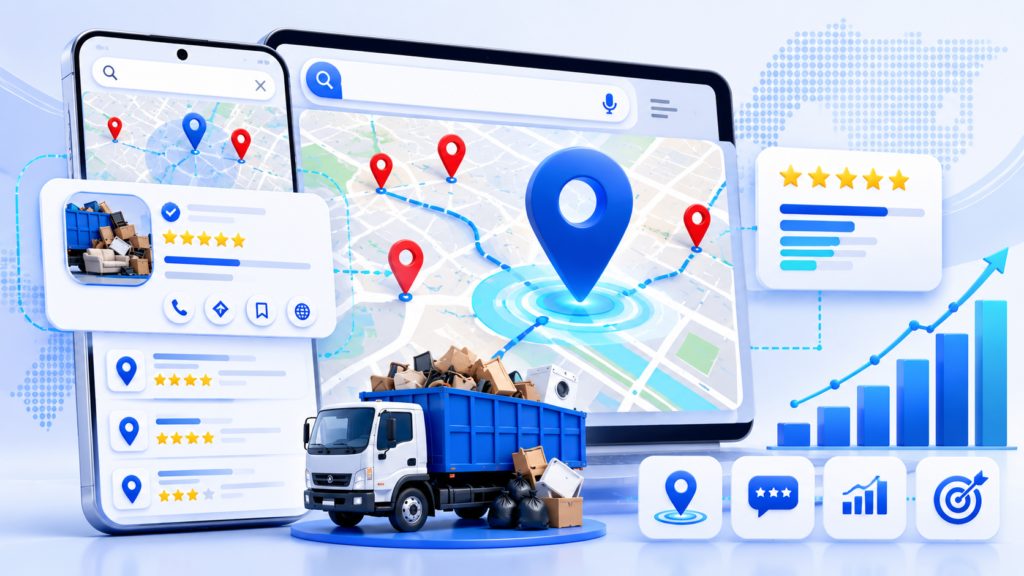
When someone searches for “junk removal near me,” Google often shows local businesses through Maps and the local results before or alongside traditional organic listings.
For a junk removal company, this is a valuable opportunity.
Why?
Because the person searching usually doesn’t want to read a 2,000-word article first. They may need someone to remove an old couch, clean out a garage, haul away construction debris, or pick up unwanted furniture.
They want to find a local company, compare a few options, and make contact.
That’s why junk removal Google Maps ranking can play an important role in generating local leads.
But getting into Google Maps isn’t simply about adding “junk removal” to your Google Business Profile.
Your business needs to send consistent and trustworthy local signals across your Google Business Profile, website, reviews, citations, content, links, and overall online presence.
In this guide, I’ll explain the major areas I would focus on when working on Google Maps SEO for a junk removal business.
Why Google Maps Rankings Matter for Junk Removal Companies
Junk removal is one of the clearest examples of a local service business.
Customers generally search for a company that can serve their specific area.
For example:
- Junk removal near me
- Junk removal in [City]
- Furniture removal near me
- Appliance removal in [City]
- Same-day junk removal
- Construction debris removal
- Garage cleanout services
These searches have strong local intent.
When your business appears prominently in local search results, you can potentially get in front of customers at the exact moment they’re looking for your service.
That’s much more valuable than simply generating random website traffic.
A good Google Maps SEO strategy can help you:
- Improve local visibility
- Increase Google Business Profile exposure
- Generate more website visits
- Increase calls and quote requests
- Build trust with potential customers
- Compete more effectively with other local junk removal companies
However, rankings shouldn’t be the only thing you measure.
The real objective is:
Visibility → Clicks → Calls → Qualified Leads → Customers
How Google Maps Rankings Work
Google doesn’t rank local businesses based on one single factor.
Local visibility is influenced by how well a business matches the searcher’s intent, where the business is located relative to the search, and how established or prominent the business appears.
Three concepts are particularly important:
Relevance
Google needs to understand what your business does.
If you operate a junk removal company but your online presence doesn’t clearly communicate your services, Google has less information to work with.
Your business profile, website, services, and content should clearly describe the services you actually provide.
Distance
Location matters significantly in local search.
A customer searching for junk removal generally wants a company that can actually serve their location.
This is one reason why having accurate service-area information is important for service businesses.
Prominence
Google also needs signals that help it understand how established and trustworthy a business is.
Reviews, mentions, links, citations, website authority, and other online signals can contribute to a business’s overall local presence.
The important lesson is that Google Maps SEO isn’t a one-setting optimization.
It’s a system.
10 Ways to Improve Your Google Maps Visibility
1. Optimize Your Google Business Profile
Your Google Business Profile is one of the first things I would review when working on a junk removal company’s local visibility.
The profile should accurately represent the real business.
Important areas include:
- Business name
- Primary category
- Relevant additional categories
- Services
- Service areas
- Phone number
- Website
- Business hours
- Business description
- Photos
- Reviews
Don’t add information simply because you think it might help rankings.
The information should accurately represent the business.
For example, if a company doesn’t actually provide a particular service, adding that service simply to target a keyword isn’t a good long-term strategy.
A properly maintained profile gives both Google and potential customers a much clearer understanding of the business.
Internal link: [Google Business Profile Optimization]
2. Choose the Right Primary Category
Your primary Google Business Profile category is an important part of communicating what your company does.
For a junk removal company, choosing the most accurate primary category should be a priority.
The category should represent the core business, not simply a service that happens to be offered.
You can also consider relevant additional categories where appropriate.
But don’t add unrelated categories just because competitors have them.
The goal is relevance.
Ask:
“If someone looked at this category, would they immediately understand what this business does?”
If the answer is yes, you’re moving in the right direction.
3. Add Relevant Services
A junk removal company may offer several related services.
For example:
- Residential junk removal
- Commercial junk removal
- Furniture removal
- Appliance removal
- Construction debris removal
- Estate cleanouts
- Garage cleanouts
- Yard waste removal
If these are genuine services offered by the business, they should be represented appropriately in the business profile and website.
This helps create a clearer connection between:
What customers search for → What the business offers
But again, don’t add services simply to manipulate search visibility.
Accuracy comes first.
4. Optimize Your Business Description
Your business description should quickly explain:
Who you are + What you do + Where you serve + Why customers should care
For example:
“We provide professional junk removal and hauling services for homeowners and businesses throughout [Service Area]. Our team helps customers remove unwanted furniture, appliances, household junk, and other unwanted items with convenient local pickup options.”
Notice that this doesn’t try to repeat the same keyword ten times.
It communicates the business naturally.
Your description should be written for potential customers first.
5. Build a Strong Review Profile
Reviews are one of the most important trust elements for a local service business.
Think about a customer comparing three junk removal companies.
Company A has:
4.9 stars — 300+ reviews
Company B has:
4.1 stars — 25 reviews
Company C has:
3.5 stars — 8 reviews
The review profile can strongly influence which company a customer feels comfortable contacting.
For that reason, junk removal companies should build a legitimate review-generation process.
After completing a successful job, you can make it easy for satisfied customers to leave an honest review.
Also:
- Respond professionally to reviews
- Thank customers for positive feedback
- Address legitimate complaints appropriately
- Don’t purchase fake reviews
- Don’t create reviews yourself
- Don’t manipulate customers into leaving misleading feedback
The best review strategy is still:
Deliver great service → Ask satisfied customers → Build genuine reputation.
6. Maintain NAP Consistency
NAP means:
Name
Address
Phone Number
Your business information should remain accurate and consistent across important online platforms.
Imagine your Google Business Profile has one phone number, while an old directory has another.
A potential customer may call the wrong number.
That creates a poor experience.
That’s why I recommend regularly checking important business listings for:
- Business name
- Phone number
- Address
- Website
- Service information
If you find outdated information, correct it.
7. Build Local Citations
Local citations are online mentions of your business information.
Depending on the business and market, these can appear on relevant:
- Business directories
- Local websites
- Industry directories
- Community platforms
- Professional organizations
The goal isn’t to submit your business to hundreds of random directories.
A better approach is to focus on relevant, trustworthy and accurate citations.
For example, if you’re serving a specific city, relevant local business resources may provide more value than a low-quality directory that exists only for SEO.
Citation building should support your overall local presence rather than become a numbers game.
8. Create Location-Relevant Website Content
Your Google Business Profile isn’t the only thing Google uses to understand your business.
Your website also matters.
Your website should clearly communicate:
- Your services
- Your locations
- Who you serve
- What problems you solve
- How customers can contact you
For example, a junk removal company serving multiple cities may benefit from useful location-specific pages.
A page targeting:
Junk Removal in [City]
should provide real information about serving that area.
Don’t simply create the same page repeatedly and replace the city name.
A useful local page might include:
- Services available
- Local customer needs
- Service-area information
- Relevant FAQs
- Clear contact options
- Internal links
- Helpful, original information
This creates a stronger relationship between your website and your local service areas.
9. Build Local Authority
Local authority doesn’t come from one backlink.
It’s built gradually through your overall online presence.
Potential authority-building opportunities can include:
- Local organizations
- Community websites
- Local sponsorships
- Industry publications
- Relevant business partnerships
- Local resources
- Quality directories
- Local media coverage
For a junk removal company, relevance is particularly important.
I’d rather see a business earn a handful of legitimate, relevant local links than build hundreds of low-quality backlinks.
The question shouldn’t be:
“How many backlinks can we build?”
Instead:
“Which relevant websites would genuinely make this business more credible?”
That’s a much healthier way to approach Local SEO link building.
10. Monitor Your Local Rankings
You can’t improve what you don’t measure.
A junk removal company should monitor how its local visibility changes over time.
Useful things to track include:
- Local keyword rankings
- Google Maps visibility
- Organic rankings
- Search impressions
- Website traffic
- Google Business Profile interactions
- Phone calls
- Quote requests
- Leads
One important point:
Don’t judge Google Maps performance from a single search on your own computer.
Local results can vary based on factors such as location and search context.
That’s why proper local rank tracking can provide a much better picture of performance.
You should also look beyond rankings.
If rankings improve but calls and qualified leads don’t, something else may need attention.
Why Your Junk Removal Business May Not Be Ranking
If your business isn’t appearing where you expect it to, don’t immediately assume that you need more keywords.
There could be several reasons.
Your Google Business Profile Isn’t Fully Optimized
Important information may be missing, inaccurate, or poorly structured.
Your Business Category Isn’t Appropriate
If Google doesn’t clearly understand what your company does, relevance can suffer.
Your Competition Is Stronger
Competitors may have:
- More reviews
- Stronger websites
- Better local authority
- More relevant citations
- Better service pages
- Stronger local signals
Your Website Doesn’t Support Your Local Strategy
Your website may not clearly communicate your services and service areas.
Your Business Information Is Inconsistent
Old or incorrect listings can create unnecessary confusion.
Your Local Authority Is Weak
Your competitors may have earned more relevant mentions and links.
You’re Targeting the Wrong Searches
Sometimes businesses focus heavily on keywords that have little commercial value.
For a junk removal company, ranking for a highly relevant local service search can be much more valuable than ranking for a broad informational keyword.
How Long Does Google Maps SEO Take?
This is one of the most common questions I hear about Local SEO.
The honest answer is:
It depends.
There isn’t a guaranteed number of days or weeks that applies to every junk removal business.
Results can depend on:
- Competition
- Location
- Current Google Business Profile strength
- Website authority
- Review profile
- Existing citations
- Local links
- Website quality
- Search demand
- Previous SEO work
Some improvements may become noticeable sooner than others.
But competitive local markets usually require consistent work over time.
That’s why I don’t recommend promises like:
“We’ll put you #1 on Google Maps in 30 days.”
SEO doesn’t work that way.
A professional approach is to establish the baseline, identify the biggest opportunities, implement improvements, monitor results, and continue refining the strategy.
What I Would Prioritize First
If I were starting a Google Maps SEO campaign for a junk removal company today, I wouldn’t immediately start building hundreds of citations or backlinks.
I’d start with an audit.
First: Check the Google Business Profile
Is the profile accurate and properly optimized?
Second: Analyze the Competition
Who is currently visible in the local results?
What are they doing well?
Where are the gaps?
Third: Review the Website
Does the website clearly communicate services and locations?
Fourth: Check NAP and Citations
Are important business listings accurate?
Fifth: Analyze Reviews
How does the business compare with competitors?
Sixth: Build the Local Strategy
Once the foundation is clear, prioritize the work based on opportunity and business goals.
This prevents SEO from becoming a random list of disconnected tasks.
Final Thoughts
Ranking a junk removal business on Google Maps isn’t about finding one secret trick.
It’s about building a consistent local presence that makes it easy for Google and potential customers to understand:
Who you are.
What you offer.
Where you operate.
Why customers should trust you.
A strong strategy combines your Google Business Profile, reviews, website, local content, citations, NAP consistency, local authority, and ongoing optimization.
And most importantly, don’t lose sight of the actual business goal.
A ranking is useful.
A phone call from a qualified customer is better.
A booked junk removal job is better still.
That’s how I recommend thinking about Google Maps SEO: not just as a ranking exercise, but as a system for generating qualified local opportunities.
Not Ranking Where Your Local Customers Are Searching?
Your potential customers are already searching for junk removal services in your market.
The question is whether they’ll find your business or your competitors.
I help junk removal companies improve their local search presence through Google Business Profile optimization, local keyword research, on-page SEO, citations, local authority building, and ongoing Local SEO strategy.
GET A LOCAL SEO AUDIT
About the Author
Saiful — Local SEO Specialist
I specialize in Local SEO with a particular focus on helping junk removal companies improve their Google Maps visibility, local search presence, and ability to generate qualified leads.
My approach focuses on practical SEO strategies including Google Business Profile optimization, local keyword research, local landing pages, citations, technical SEO, content strategy, and local authority building.
Join The Conversation